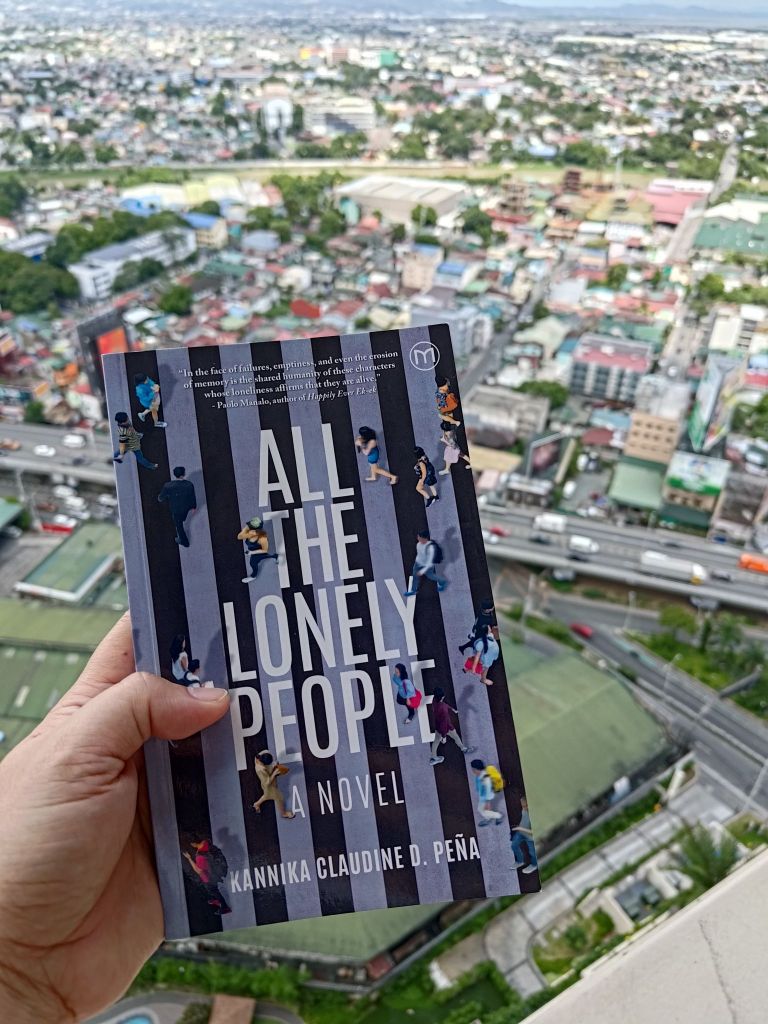
Book Review of All The Lonely People by Kannika Claudine Peña
In one of our kotse chronicles, dok bb mentioned that he doesn’t cry much because his tear ducts are tinier than any other person. Instead, whenever he feels like crying, it was his runny nose doing the deed. Whenever he feels deep sadness, he said, “kinokotse ko lang. huling hagulgol ko ay yung huling heartbreak ko eh.” I guess at least with movement, he can find his release (without judging his runny nose and his huge mess of used tissue paper).
Movement and mementos are the big themes in Kannika’s first novel of remembering loss and its adjacent emotions of grief, and how we have found ourselves looking for a company to share our loneliness with. With company comes empathy and reason, and may it not be a concrete form of happiness, but rather a release and a relief. Then hope. After all, hope if what gives us tenacity to brave the rage we experience everyday in the Metro.
Mandirigmang imortal, amirite?
If you are burned out from the daily life of the Metro, this time may not be a perfect chance to read the novel. Maybe this book is meant for people who wanted to enjoy the slow days in their homes, or want to relish the feeling of rawness of emotions. I can only opine on my reading experience, since I finished the whole book during the hours when the Globe Internet is down in Pasig area.
The six stories in the novel were done in a “hand-off” fashion, where the omniscient POV is moved from one character to another, its main goal is to share their little sob story. At the center of it all is Marya, and her own history of loss and longing for company, her sentiments poured out to the Lost and Found Logbook of the old Apartelle where she is currently working (and living in).
What I liked about the novel is how the story weaves and how it pulls the emotions out of me. I feel that my chest hurt everytime I read a snippet of their sad histories, and at some instances, I see my persona as a composite from the characters in the novel. I reflected at the what-ifs (like, if I was Gemma, will I still be ok managing my mother if she has Alzheimer’s?) I even see my work colleague in Cindy’s story. I loved how relatable the stories are.
Also, the author has effectively inserted her criticisms in our love for sad tropes (“Sadness that sells because it’s everyone’s sadness”), the dismal commute and horrendous traffic (“This city has no time for your heartbreak. So you move on”), and her leeway to explain why there are tendencies to romanticize this chaotic city (“But perhaps she’s looking for a way to feel again”). The universality of stories and the feelings it evoked within me are remarkable. For less than 30 pages, I shed my tears as if the loss was my own. Good thing I don’t have dok beside me because it is hard to explain why are you crying over a page you just read.
I think what wanes the reading experience for a bit is my introduction to Cindy’s story. It felt abrupt. It’s the sudden insertion, nothing weave-like. I was so used to the chaotic EDSA or slower moments in Pasay (where I think Via is from), and then Cindy opened her story with “Pillow crease on face.” The momentum faltered from there. And just before the novel ended, the connection was made too convenient. Also, I personally felt that the stories of queer characters (Jona and Dan Ian, respectively) are tokens of inclusivity. Nonetheless, they are relevant stories. Including their snippets means that all of us walk and manage the loneliness of everyday.
What redeemed me in the end is the seemingly magical realism / romantic narrative at the bus station that even I (as the reader) was rooting for. That was so effective! It feels like watching the final sequence of Kimi No Nawa, two total strangers on the different lines of trains getting off on stations abruptly and meeting at the Suga Shrine.
“It’s possible to be content with whatever and whoever is right there, even and especially with the knowledge that they will soon be gone, that nothing lasts forever—love, happiness, but also heartbreak, sadness, pain.” And I thank this novel for giving me back my reading groove again, after managing the more challenging novels at the first half of the year. Thanks to Kannika for giving me a chance to slow down and just cry it out and breathe.
 mariaellabetos.com