Movement and Memento

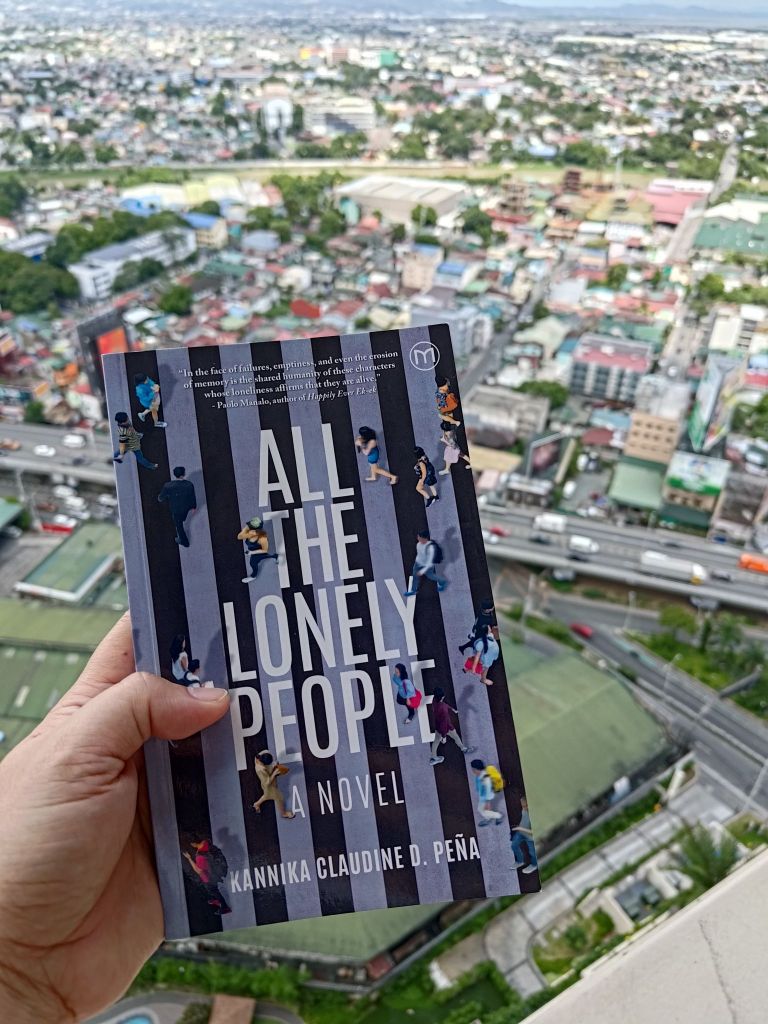
Book Review of All The Lonely People by Kannika Claudine Peña

In one of our kotse chronicles, dok bb mentioned that he doesn’t cry much because his tear ducts are tinier than any other person. Instead, whenever he feels like crying, it was his runny nose doing the deed. Whenever he feels deep sadness, he said, “kinokotse ko lang. huling hagulgol ko ay yung huling heartbreak ko eh.” I guess at least with movement, he can find his release (without judging his runny nose and his huge mess of used tissue paper).

Movement and mementos are the big themes in Kannika’s first novel of remembering loss and its adjacent emotions of grief, and how we have found ourselves looking for a company to share our loneliness with. With company comes empathy and reason, and may it not be a concrete form of happiness, but rather a release and a relief. Then hope. After all, hope if what gives us tenacity to brave the rage we experience everyday in the Metro.

Mandirigmang imortal, amirite?

If you are burned out from the daily life of the Metro, this time may not be a perfect chance to read the novel. Maybe this book is meant for people who wanted to enjoy the slow days in their homes, or want to relish the feeling of rawness of emotions. I can only opine on my reading experience, since I finished the whole book during the hours when the Globe Internet is down in Pasig area.

The six stories in the novel were done in a “hand-off” fashion, where the omniscient POV is moved from one character to another, its main goal is to share their little sob story. At the center of it all is Marya, and her own history of loss and longing for company, her sentiments poured out to the Lost and Found Logbook of the old Apartelle where she is currently working (and living in).

What I liked about the novel is how the story weaves and how it pulls the emotions out of me. I feel that my chest hurt everytime I read a snippet of their sad histories, and at some instances, I see my persona as a composite from the characters in the novel. I reflected at the what-ifs (like, if I was Gemma, will I still be ok managing my mother if she has Alzheimer’s?) I even see my work colleague in Cindy’s story. I loved how relatable the stories are.
Also, the author has effectively inserted her criticisms in our love for sad tropes (“Sadness that sells because it’s everyone’s sadness”), the dismal commute and horrendous traffic (“This city has no time for your heartbreak. So you move on”), and her leeway to explain why there are tendencies to romanticize this chaotic city (“But perhaps she’s looking for a way to feel again”). The universality of stories and the feelings it evoked within me are remarkable. For less than 30 pages, I shed my tears as if the loss was my own. Good thing I don’t have dok beside me because it is hard to explain why are you crying over a page you just read.

I think what wanes the reading experience for a bit is my introduction to Cindy’s story. It felt abrupt. It’s the sudden insertion, nothing weave-like. I was so used to the chaotic EDSA or slower moments in Pasay (where I think Via is from), and then Cindy opened her story with “Pillow crease on face.” The momentum faltered from there. And just before the novel ended, the connection was made too convenient. Also, I personally felt that the stories of queer characters (Jona and Dan Ian, respectively) are tokens of inclusivity. Nonetheless, they are relevant stories. Including their snippets means that all of us walk and manage the loneliness of everyday.

What redeemed me in the end is the seemingly magical realism / romantic narrative at the bus station that even I (as the reader) was rooting for. That was so effective! It feels like watching the final sequence of Kimi No Nawa, two total strangers on the different lines of trains getting off on stations abruptly and meeting at the Suga Shrine.

“It’s possible to be content with whatever and whoever is right there, even and especially with the knowledge that they will soon be gone, that nothing lasts forever—love, happiness, but also heartbreak, sadness, pain.” And I thank this novel for giving me back my reading groove again, after managing the more challenging novels at the first half of the year. Thanks to Kannika for giving me a chance to slow down and just cry it out and breathe.
Sa baba ay ang Universal Robina at ang C5

Lights Follow (from the Previous Century)

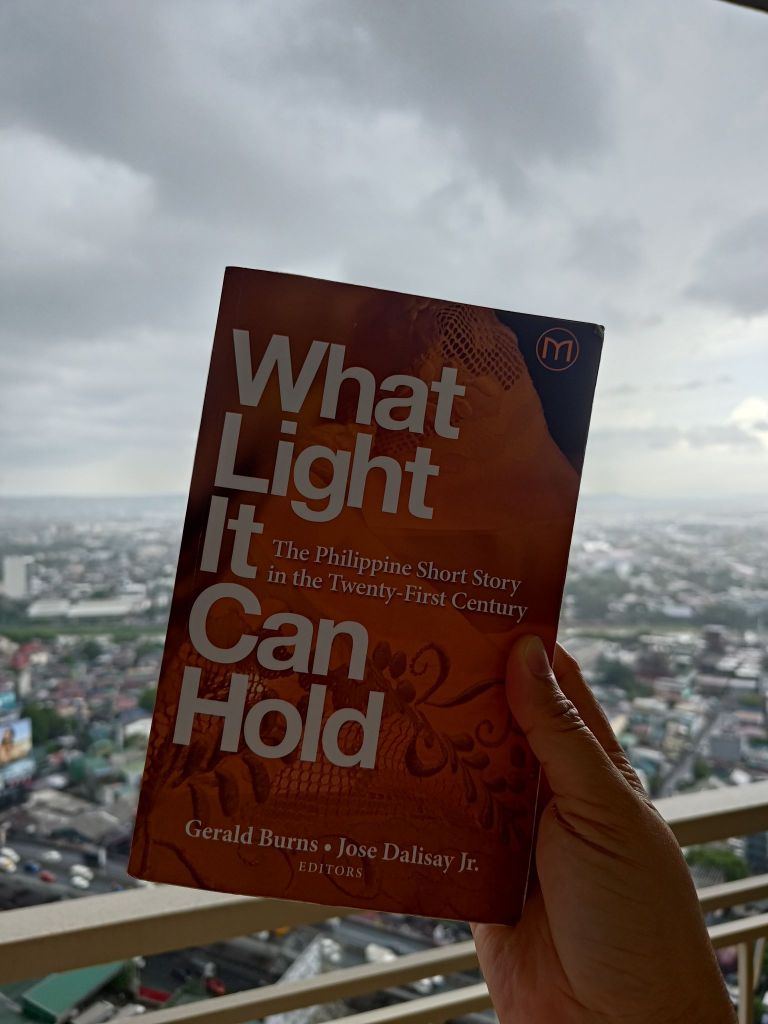
Book Review of What Light It Can Hold Edited by Gerald Burns and Jose Dalisay, Jr.

What Light It Can Hold is a collection of Filipino writers with their stories released after the millenium bug hey-days. I admire the curation, it has representations across the regions and also the male, female and queer demographic (please correct me if I am wrong on this).

I read the collection at a random pace. In one sitting, I read the first and the last story, and in the other days, I pick whatever I feel like reading. The first and the last story indeed tie the theme behind the books title. Casocot’s Things You Don’t know ended in a sunset (or dusk) scene of confessions and a touch of hope, while Groyon’s The Haunting Martina Luzuriaga ended with a new day with its sunbeam erasing the sad past and an epiphany after years of solitude. I appreciate how endings and beginning weave through these respective stories. As the introduction alludes, the book echoed the idea of fragility and illumination.

What I find challenging (aside from my daily Corporate grind) is the search for the contemporary themes that seem to be limited across the collection. I was actively looking for the use of social media, online bullying and cancel culture, the emergence of memes, bekimon vocabulary, or even some snippets of millennial activities of undeground indie bands, collective jogging, and heavy use of technology, or bitcoin grind. Where is the onslaught of the 2008 Financial crisis, or even scamming via Multilevel Marketing? Though the stories are okay with its overarching themes of injustices and powerplay, family bonds, or Love, maybe I was actively reaching for a distinct flavor of a craft (being a millennial myself, overusing parenthesis, oxford commas and em dashes — a punctuation politically being a pet peeve by AI detectors).

What the collection showed me instead are remnants of the B-type movie from 80’s (Tenorio’s Monstress), or early 90’s sea travels (Pagliawan’s Manila-Bound), or late ’90s elementary school bullying (Habana’s The Mop Closet). All of them are marvelous on their own ways — especially the moniker “Monstress” — but these allusions are not in 21st century, but rather, they are remnants of the previous one being carried by the writers themselves. The only hallmark 21st century storyline for me personally is seething through Bengan’s Armor and his storytelling of the Davao Death Squad conflict (if I may say so).

I do hope that there will be another collection that can tackle the more recent events or timelines, or maybe the pens respsonsible for them belong to us now, the contemporary consumers and players of the post-pandemic hyperrealities.

For now, I soldier on.

My question after seeing the dark skies and its looming heavy rainfall

Booktokish: Snippets of Content Creator

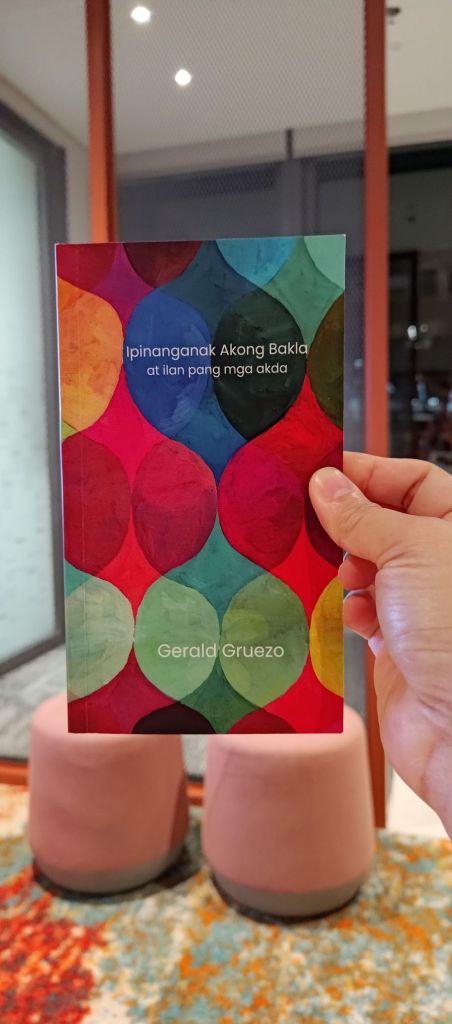
Book Review of Gerald Gruezo’s Pinanganak Akong Bakla at ilan pang mga akda

Nakakabitin!

Tunay ngang patikim ang mga akda niya rito sa litol chapbook niya! Maraming salamat sa Akdang Pinoy dahil nanalo ako sa raffle nila, at plano ko sana itong ipa-raffle papunta sa ibang interesado ng kanyang mga akda, because sharing is caring! 😉

Limang titulo ang narito. Yung unang apat, kwentong buhay niya. Pagpapakilala niya, ganun. Catchy ang unang akda kasi andaming em dash— alam mong madaldal siya sa personal (with lots of social media channels, andami nga niyang nagiging engagement!). Isa pa, parang nakapagbasa ka rin ng blog entry sa Una at Ikaapat niyang entry sa libro. Yung ikaapat, sobrang conversational. Bigla kong naalala ang Unang Reglang kwento ni Beverly Wico Siy sa una niyang Koleksyon na It’s a Mens World. Ang galing lang.

As a geriatric millennial, I recommend the teenagers and younger GenZ demographic to try his works. Lalo na yung huli niyang entry dito na pinamagatang “Unang Kabanata”, kasi promising ang fiction. Pwedeng pocketbook na folklore, pwede ring tungkol sa mga kwentong bayan ng Quezon (kung saan siya lumaki). Sana masubukan nila basahin ang libro (kahit limitado ang kopya, baka naman may reprint ang Balangay in the future di ba?)

I also would like to commend Balangay Productions as the publisher kasi ang ganda ng kulay ng pabalat. Nakakahalina. Pati yung print ng font at ang edit ng mga gawa, malinis. #SanaAll aesthetics is life, charot. Kapag nag-reprint ito, wagi ang mga followers ni @geraldthebookworm for sure!

#BlessedbydaBes Swalla!

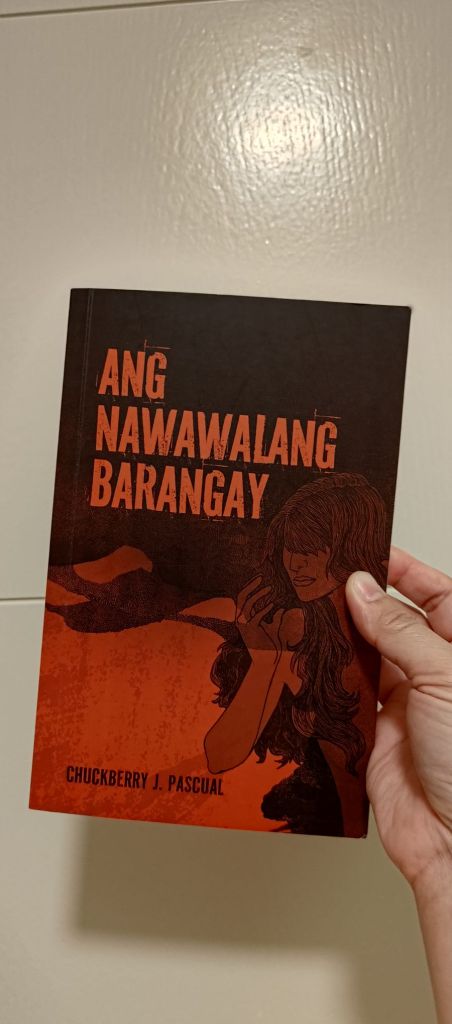
Book Review of Chuckberry Pascual’s Ang Nawawalang Barangay

At first, I thought this would be a usual novel with a straight-forward conflict, resolution, and ending; it is only after rereading Ms. Carolone Hau’s blurb that I realized sir Chuck’s brilliance in storytelling:

Darkly comic, sharply observed, and perfectly pitched to capture the living language of our times, Chuckberry J. Pascual’s Ang Nawawalang Barangay explores the politics of despair and disempowerment, the dark allure of religion and social media, and the neccessity of resisting the angels when they whisper, “Swalla. Sa wala tayo nagmula at sa wala rin babalik.”

Initially, I was confused at the way the story unfolded, because the world-building felt out of reach. Siguro sadyang ganun ang estetiko ng Malabon— malayo sa Kapasigan, mas malapit sa Bulacan. Pero kung tutuusin, ang Talong Punay ay nakakaranas rin ng mga araw-araw na kalakaran ng barangay: may “bureaucratic” galawan, lumang parapernalya at kagamitan, may salon sa gedli at may tindahan ng ulam. Bree’s barangay is also like the Pembo where I grew up. Ang cute lang kasi andami mang kakaiba sa kanila, meron ding pagkakatulad sa kinagisnan ko.

Nag-dawn lang ang diwa ng nobelang ito sa mismong Big Night scene. Hindi ko alam, pero mula nang mabasa kong nagpakita si Donya Mary Juliet, parang biglang pumasok sa imagination ko na kamukha niya si Cynthia Villar: may mga alipores at nakasipat lang sa malaking barangay na pwede gawing subdivision (like Las Piñas), tapos yung stage ng mga sumasayaw kineso ay parang yung Guadalupe-EDSA overpass, looking at the squatter’s area ng Guadalupe Viejo looban burned to dust— na ngayo’y binakurahan na ng SMDC (katabi ito ng seminaryo sa Guadalupe-EDSA; hindi ko na tukoy kung dere-derecho na ang pagtayo ng condo dun, kasi andaming Pending Class Action sa korte dahil sa laki ng sunog na nangyari).

Ang ganda rin ng paraan ng pagku-kwento ni Chuckberry. Tukoy mo na boses niya! I don’t know why I haven’t sensed it in his earlier works (Ang Nawawala short story collection), but maybe mas nagiging buo yung tinig niya kapag mas mahaba pa sa maikling kwento ang katha.

Ang galing! Excited na ako sa magiging Book Talakayan namin tungkol dito!

A Look at Life and Love through Hiking Trails

Book Review: You are Here by David Nicholls

Upon receiving the kindle version of this novel, I thought to myself, “Wow, this could be my new life manual”, and I harked at the imagination because (1) I expected this to have less passionate and more pragmatic leads, and (2) I haven’t hiked Cumbria, only Pulag (and other mountain regions of Luzon) and Japanese alps.

The topography of the walking trails seemed to be wet and muddy even on the UK Summer as I read along, and it kind of contributed to the charming vibe of the reading experience. Marnie, the copyeditor who attained the WFH gig post pandemic lockdowns, finally embarked on a trip to the Northern England as she was seemingly forced by her friend Cleo (because the latter wanted the former to be “out there”), and met Michael, the geography teacher who has a complicated marriage.

What I find fascinating about this novel is how David inserted the narratives of the characters in the trails, describing the mood and the cadence of the story with the section of the trails they traverse. It’s very much different with Philippine mountains and terrains, but I am a bit envious that he was able to infuse the socially awkward conversations, and gushing then to lashing and those silent heaving moments. I remember hiking Batolusong with a tinder date and I only have heaves and sighs and random “tara, magpicture tayo dun!” because the mountains of Rizal is very hot in the summer. Maybe trekking Cumbria for ten days is good to win over a random friend (or a potential romance), or at least a good checkpoint if your special someone is still into you.

With all these walks, I find myself relatable to Marnie, as she has okay livelihood, sometimes sadgurl but oftentimes content. She has the discipline and a strong work ethic, hyperfocused on the deadline, and there are moments that she wakes up and simply looked at the ceiling. She has the moments where she is wary of romance, some snippets of curating her anecdotes, and trying her best to compartmentalize her breakdowns. What I can advise Marnie is that she can schedule her “crying session”. That way, she can be more productive when deadline is nearing, haha.

I also liked the open-ended tone of the novel, very much different from my OG life manual called One Day. Practicalities do come as a higher priority when you get older. Nonetheless, you have all the right to be hopeful and YOLO. I enjoyed my long and in-and-out reading pace because I have the leeway to check Cumbria on Googlemaps and hopefully save up some money to simulate the same in the future.