Hajimete no Onsen Taiken

(My very first Onsen experience)

08 October 2025
19:15
Yol Guesthouse
Takeo City, Saga Prefecture

In the same entrance I found myself excited to try this Town’s proof of jumping back to its pre-lockdown years: Onsen is now back for business!

Takeo Onsen is a sleepy town. Like Hida City in Gifu. Two main differences are: Onsen is more famous in Takeo and Beef is better in Gifu.

In the genkan I find myself being lost with two sets of lockers: One for the outside shoes, the other for your phone and other valuables. Turned out, you cannot use your phone inside. Let alone take photos upon entering the Moto Yu bathhouse. I find myself lost, yet again, in a community of obaachans bringing their luxurious soaps and serums, their designer bags locked away with the ¥100 old-style coin locker. Turned out, yet again, I was the most morena and the most fuwa-fuwa (plumpiest) contender to do the ceremony. I was also the dumbest: I forgot my personal care set from the coin locker. I only brought my adaptability life skill and a towel strip for my hair.

At the wash area, there are two huge bottles, free to use. The Liquid body wash and the combined shampoo and conditioner are on standby. I hope I won’t get dandruff agter using these Japanese concoctions on my scalp.

While shampooing I caught myself being stared at by the obaachan on my right. Was she sizing me up? Do I look like gaikokujin enough? Even though I lacked the expertise of reading kanji, I can speak their language… nanto naku. Somehow.

When I was about to execute the script in my head with “Shiitsure desu ne,” or in Tagalog, “Nakakabastos naman ate,” a voice from my far left said something like [Going to the pool]. But with a Hakata ben — a different sound from the Far East Tokyo (and their differing Keigo or Japanglish), or the midwest Kansai region (with statements ending with a meow sound).

Ahh. These obaachans must be friends.


After my intense wash and multiple use of the little basin to acclimitize my overweight physique, I fixed my hair. Then I covered it with the mini towel I brought, And finally, dipped my legs to the 44 celsius Onsen heat. It stings at first, not being used to the very hot pool, together with the risk of being easily dehydrated. Its first three minutes a painful reminder that we do not have this back home — that little posporo condo got no built-in heater in the shower — because I don’t want my electric bill to balloon with my never-ending mortgage! Then comes that soothing comfort, a scene from the anime shouting “woooh!!! kimochii!!!” and then the pause, just chilling and watching the steam take away the fatigue and the bad vibes.

The obaachan from before is about to join me in this large hot pool, yet stationed herself on the opposite end, sitting beside her “friend” (neighbor, perhaps?). Other obaachans went to the cooler section, their backs very red from where I am now seated.

These obaachans, I wonder if they do this regularly? Do they establish a routine of onsen trips? And if they do, won’t they feel awkward?

If Tricia and Lyra and I plan a trip together and go to an onsen as a culminating itinerary and a test of companionship, will they be absolutely delighted? Or will they respond with the polarizing take — being terrified? Aba’y paano na ang test of friendship na yan? Lol. Maybe at this point, it will be harder for it to come true, since both of them are already married — and one of them already have a boy having random fits of kakulitan and temper tantrums.

And maybe instead of waiting for the “culminating itinerary”, I went for it and experience the onsen in solitude.


ALONE X TOGETHER: A beauty that is transient and fleeting in a shared space. Sobremesa can be a nice ring to it, although the spanish loan-word is more apt to a dining table, a perfect setting to the current ordeal of writing a creative nonfiction with a Spanish-Japanese haafu eating bento in front of me. Konbanwa, ate!

I’d like to link this little onsen adventure as a wabi-sabi experience. After all, taking a bath is supposed to be a solitary activity. But onsen made it more unique, akin to a sense of community. Without speaking to each other, you share the same desire of removing fatigue and the same challenge of scrubbing your own back with the little towel one tows upon sliding the door open to the huge hot basin.


Flashing back to the logistics of the hot bath, one obaachan said she’ll go ahead and dry up. Upon standing I saw her very red back, her skin as perfect as the newly-cooked shrimp. Meanwhile, I stared at my legs and it looked like a perfectly roasted chicken: a reddish-brown specimen ready to be eaten. Ano raw?! Hahaha tama na nga! Hmn! I got myself changed and hair dried. Upon buying a cold bottle of fanta I saw the other obaachan and shouted “Oi! Ikku da tou!” Not directed to me, but to an old man watching the weather forecast for the next day, his wet hair too close to the TV.

And after a little post-onsen foot massage for ¥100, I exited the place.
Sleepy, yet tottemo satisfied.

A Love Letter from an Anxious-attached Woman with a Manic Episode

Dearest M,

How is your recent life in Idaho? And why are you not texting me? Do you enjoy your trips on that other side of the world?

So. In the next days of our lives, we shall spend in silence? Like minding ourselves be sucked in our respective worlds, watching our own interests in a nook called a mobile phone? What about the conversations that we used to have? When I tried to engage in sharing my stories, you just dismiss it with a humorless jest, and making it repetitive, a routine unconscientiously performed after days—fuck it, months—of absence?

It feels convoluted, meeting this person.

Does this mean that I learn to settle in this dynamic that bears no joy, not even a high, “for now”?

Intellectualize this: Were you an absent partner on your previous marriage, resulting to a third party you caught in the act? If yes, most likely, your history will repeat itself. You are now on the brink of reprising the role your absent father did to your mother.

And its absence lingered on this timeline.

I miss you.
I am sorry for being this destructive and resentful. It is tough managing an avoidant.

I love you.
But sometimes, I do not love you because of what we have now.
“Out of sight, out of mind.”

And I do not want to hate myself for it. I guess this is how our love works, right?

Sometimes, the kilig comes as a huge tsunami wave whenever you come home and we share the silent space together, and yet, sometimes I am resenting that same silence whenever we independently face our own struggles.

I think this is our kind of love, right? And after all these years, I am still navigating this with sonder and wonder that maybe our storyline is not as unique as the others. Maybe, we have that sentiment that is transcendent, like the novels that we read.

Maybe at the end of the day, loving is about choosing.

And even though moments hurt and memories fade, I choose you.

Break or no break,
E.

Poetics: Actual submission to the JFF25 contest in facebook page. I hope to win free tickets or anything. If I don’t win, meh, then you see my thought process in my current struggle of not seeing my date in the last five months of our lives.

Filipinong Southern Tagalog

Henlo Jesson,

Kumusta ka jan sa Norte? Random: alam mo bang may aklat ng mga tula na galing sa lalawigan mo? Ay kainaman nga! Kailangan ko lagi ng Diksyunaryong Pilipino para lang malaman ang kahulugan ng mga parirala at saknong. Na-realize ko lalong wala akong probinsya. Pinanganak sa Pasay, nag-aral sa Makati, nagta-trabaho sa Taguig, at kasalukuyang nakatira sa Pasig. Mga probinsyudad noong dekada nobenta na naging melting pot ng wika at mga memes at code-switches.

Pero sa koleksyon na ito, parang akong bumalik sa high-school required reading na may trabaho ang paghahanap sa kaluhugan ng mga talinghaga. Bigyan kita ng sampol:

POSIBILIDAD
(ni Brixter Tino)

Paano mabalangkas ang paglansag ng tanaw,
ang dungis at ang duklay ng diwarang dahilan?

  1. Mga kelangan ng diksyonaryo — lansag, duklay, diwara. Tatlong salitang hindi ginagamit sa NCR. Ay kainaman! (sabi nga ni Mama, ang Batangueña)
  2. Pag-unawa sa metapora (ang galing, pwede palang tula form ang mga tanong sa buhay!) — I digress, bobo ako sa tula at ito ang unang impression: “Paano raw isusuma ang watak-watak na mga pananaw at ang rawness (the “dungis”) at ang hifalutin (the “duklay”) na mga mabusising reasoning (ng tao ito siguro?).” Through possibilities. Galing!!!

Maganda ang mga berso ng tula, pero ang ariba ng diwa, napakatagal. Kaya nakakasura siyang basahin. Pwede talaga ito sa mga estudyanteng sadyang nag-aaral ng linggwistika, or may oras na maghanap sa diksyunaryo, or people who are naturally curious about the work. Sabi ng maraming kumento at blurb sa libro, magaling si Brixter kasi naipon niya lahat ito (at medyo na-intimidate ako sa uniqueness ng #danas niya dito sa kamaynilaan; polarizing kami kasi taal ako ng 🎵🎶 Mahal kong Maynila~🎵🎶).

Actually, malapit na ang Book Talakayan namin dito, July 19 na, sa PUP! Kung bababa ka, magsama ka ng mga friends o bisitahin mo yung Pinoy Reads Pinoy Books tas catch-up naman tayo. Tungkol sa wika o memes o anumang ganap ng mga kanya-kanyang lovelife kineso haha!

Hopefully maka-akyat ako jan at samahan mo naman ako mag-hike sa Ulap! See you uwu!!!

-Ella

Movement and Memento

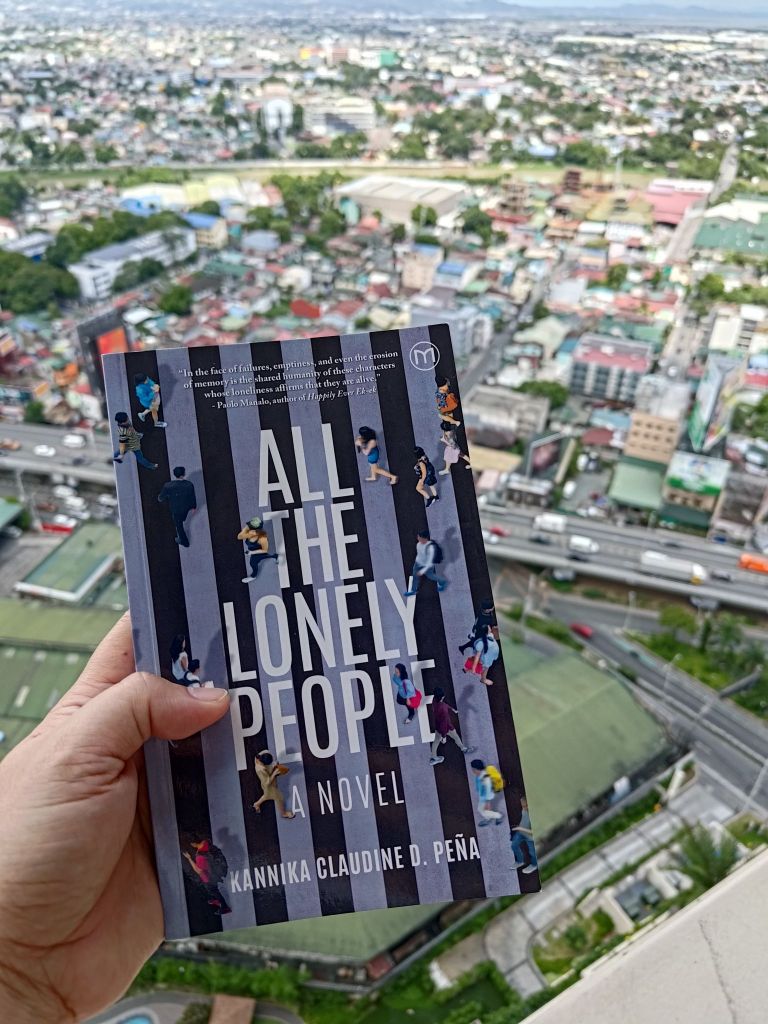
Book Review of All The Lonely People by Kannika Claudine Peña

In one of our kotse chronicles, dok bb mentioned that he doesn’t cry much because his tear ducts are tinier than any other person. Instead, whenever he feels like crying, it was his runny nose doing the deed. Whenever he feels deep sadness, he said, “kinokotse ko lang. huling hagulgol ko ay yung huling heartbreak ko eh.” I guess at least with movement, he can find his release (without judging his runny nose and his huge mess of used tissue paper).

Movement and mementos are the big themes in Kannika’s first novel of remembering loss and its adjacent emotions of grief, and how we have found ourselves looking for a company to share our loneliness with. With company comes empathy and reason, and may it not be a concrete form of happiness, but rather a release and a relief. Then hope. After all, hope if what gives us tenacity to brave the rage we experience everyday in the Metro.

Mandirigmang imortal, amirite?

If you are burned out from the daily life of the Metro, this time may not be a perfect chance to read the novel. Maybe this book is meant for people who wanted to enjoy the slow days in their homes, or want to relish the feeling of rawness of emotions. I can only opine on my reading experience, since I finished the whole book during the hours when the Globe Internet is down in Pasig area.

The six stories in the novel were done in a “hand-off” fashion, where the omniscient POV is moved from one character to another, its main goal is to share their little sob story. At the center of it all is Marya, and her own history of loss and longing for company, her sentiments poured out to the Lost and Found Logbook of the old Apartelle where she is currently working (and living in).

What I liked about the novel is how the story weaves and how it pulls the emotions out of me. I feel that my chest hurt everytime I read a snippet of their sad histories, and at some instances, I see my persona as a composite from the characters in the novel. I reflected at the what-ifs (like, if I was Gemma, will I still be ok managing my mother if she has Alzheimer’s?) I even see my work colleague in Cindy’s story. I loved how relatable the stories are.
Also, the author has effectively inserted her criticisms in our love for sad tropes (“Sadness that sells because it’s everyone’s sadness”), the dismal commute and horrendous traffic (“This city has no time for your heartbreak. So you move on”), and her leeway to explain why there are tendencies to romanticize this chaotic city (“But perhaps she’s looking for a way to feel again”). The universality of stories and the feelings it evoked within me are remarkable. For less than 30 pages, I shed my tears as if the loss was my own. Good thing I don’t have dok beside me because it is hard to explain why are you crying over a page you just read.

I think what wanes the reading experience for a bit is my introduction to Cindy’s story. It felt abrupt. It’s the sudden insertion, nothing weave-like. I was so used to the chaotic EDSA or slower moments in Pasay (where I think Via is from), and then Cindy opened her story with “Pillow crease on face.” The momentum faltered from there. And just before the novel ended, the connection was made too convenient. Also, I personally felt that the stories of queer characters (Jona and Dan Ian, respectively) are tokens of inclusivity. Nonetheless, they are relevant stories. Including their snippets means that all of us walk and manage the loneliness of everyday.

What redeemed me in the end is the seemingly magical realism / romantic narrative at the bus station that even I (as the reader) was rooting for. That was so effective! It feels like watching the final sequence of Kimi No Nawa, two total strangers on the different lines of trains getting off on stations abruptly and meeting at the Suga Shrine.

“It’s possible to be content with whatever and whoever is right there, even and especially with the knowledge that they will soon be gone, that nothing lasts forever—love, happiness, but also heartbreak, sadness, pain.” And I thank this novel for giving me back my reading groove again, after managing the more challenging novels at the first half of the year. Thanks to Kannika for giving me a chance to slow down and just cry it out and breathe.

Sa baba ay ang Universal Robina at ang C5

Lights Follow (from the Previous Century)

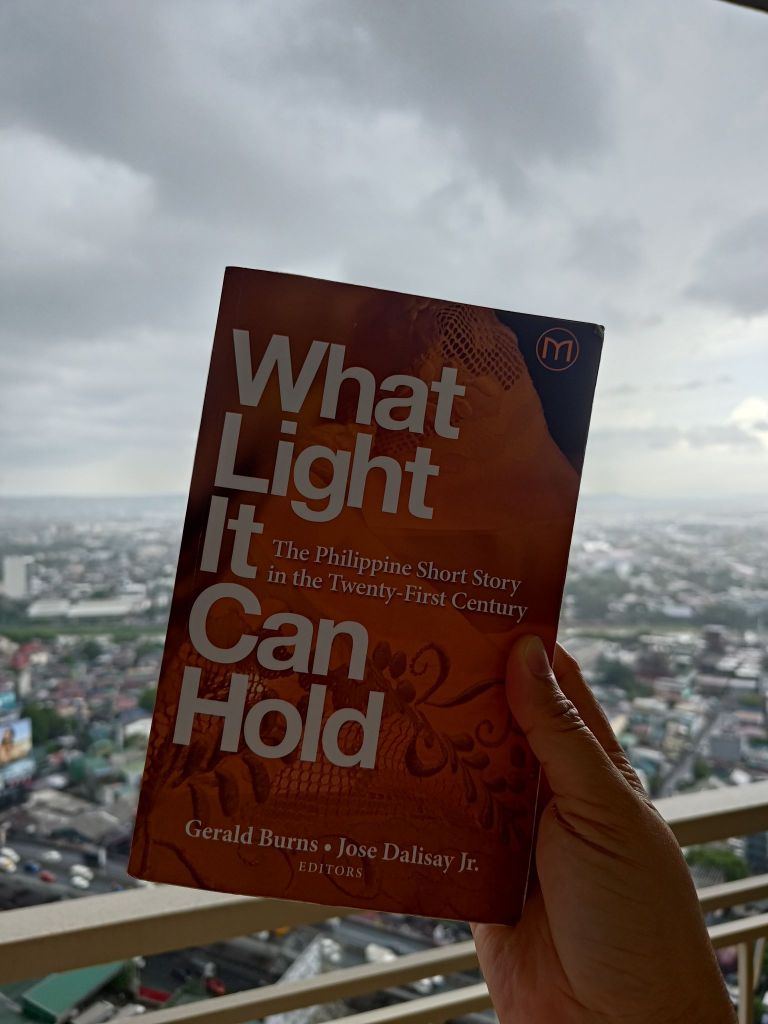
Book Review of What Light It Can Hold Edited by Gerald Burns and Jose Dalisay, Jr.

What Light It Can Hold is a collection of Filipino writers with their stories released after the millenium bug hey-days. I admire the curation, it has representations across the regions and also the male, female and queer demographic (please correct me if I am wrong on this).

I read the collection at a random pace. In one sitting, I read the first and the last story, and in the other days, I pick whatever I feel like reading. The first and the last story indeed tie the theme behind the books title. Casocot’s Things You Don’t know ended in a sunset (or dusk) scene of confessions and a touch of hope, while Groyon’s The Haunting Martina Luzuriaga ended with a new day with its sunbeam erasing the sad past and an epiphany after years of solitude. I appreciate how endings and beginning weave through these respective stories. As the introduction alludes, the book echoed the idea of fragility and illumination.

What I find challenging (aside from my daily Corporate grind) is the search for the contemporary themes that seem to be limited across the collection. I was actively looking for the use of social media, online bullying and cancel culture, the emergence of memes, bekimon vocabulary, or even some snippets of millennial activities of undeground indie bands, collective jogging, and heavy use of technology, or bitcoin grind. Where is the onslaught of the 2008 Financial crisis, or even scamming via Multilevel Marketing? Though the stories are okay with its overarching themes of injustices and powerplay, family bonds, or Love, maybe I was actively reaching for a distinct flavor of a craft (being a millennial myself, overusing parenthesis, oxford commas and em dashes — a punctuation politically being a pet peeve by AI detectors).

What the collection showed me instead are remnants of the B-type movie from 80’s (Tenorio’s Monstress), or early 90’s sea travels (Pagliawan’s Manila-Bound), or late ’90s elementary school bullying (Habana’s The Mop Closet). All of them are marvelous on their own ways — especially the moniker “Monstress” — but these allusions are not in 21st century, but rather, they are remnants of the previous one being carried by the writers themselves. The only hallmark 21st century storyline for me personally is seething through Bengan’s Armor and his storytelling of the Davao Death Squad conflict (if I may say so).

I do hope that there will be another collection that can tackle the more recent events or timelines, or maybe the pens respsonsible for them belong to us now, the contemporary consumers and players of the post-pandemic hyperrealities.

For now, I soldier on.

My question after seeing the dark skies and its looming heavy rainfall

A Little Letter A Minute After Three

Hello, what is Meta Professional mode? I just intend to keep the followers and friends from the past to be updated with whatever’s happening with me. Suddenly, tadah! There are offers for ads and “subscribe to Meta Verified”.

How is me, you wonder? Heto, pagod.

In the wee hours of morn, I am eating my leftover ramen while trying my best to finish the books I am currently reading (for Pinoy Reads Pinoy Books and Nakita sa Booksale pero Hindi Binili). I wasn’t able to write creatively at the moment since my mind is vexed from frustrations of the Corporate, topped with difficult Market movements of Late-stage capitalism and looming anxiety of 5 days onsite expected later this year.

I miss my amigas. We only touch-base in our group chats. I miss the PRPB after-parties and/or walwal nights. And I miss the moments when I can just grab my bag and hike Benguet mountain ranges, or go to Palawan to feel the sea breeze. I may live in a “ivory tower” away from the floods, but I am not invincible not to feel lonely (or be out of touch with reality. yet. I guess?)

You can actually see my bogsa moments in my instagram stories, my older entries in my personal website. Tiktok contents are stale. Maybe I can put a video out sometime this weekend.

I hope you are okay, dear friend. I may be TTTHHHHIIIISSSS tired, but I make a point to set a time to destress. I hope you do, too. Take care of your health. With leptospirosis and coughs and colds around us, I hope you get yourself some vitamins. Don’t forget to drink water. And never forget to rest.

Because when we rest, we dream. And the further we dream, we envision.

And then, we rage against the machine.

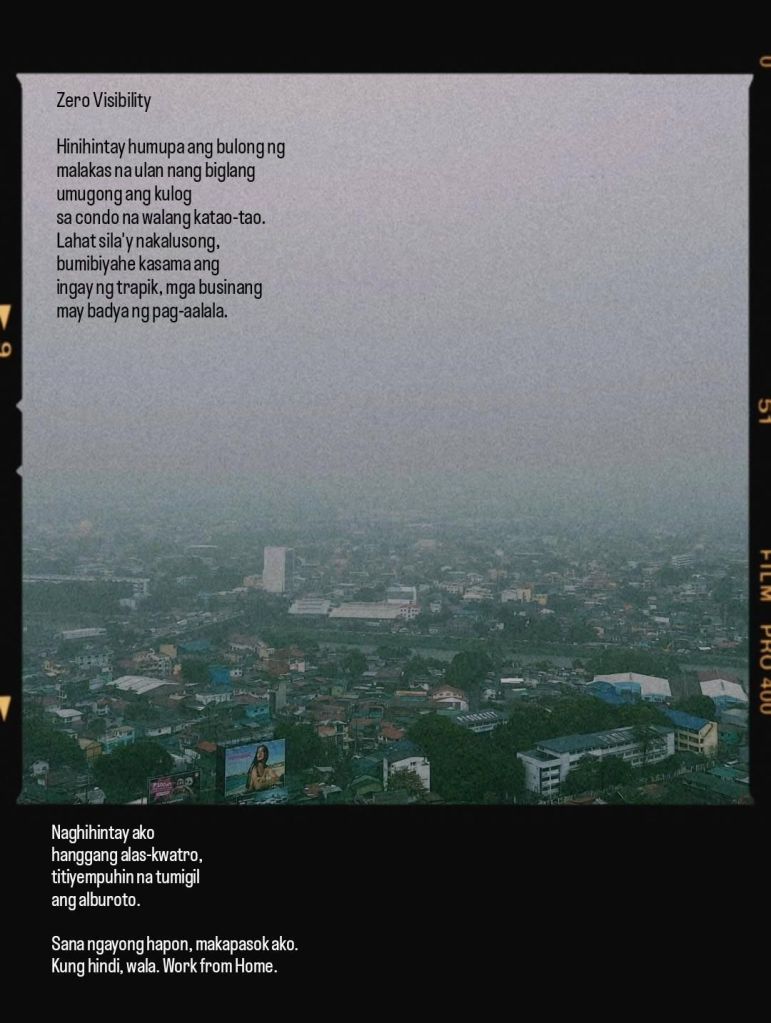
Zero Visibility

C5 and Ilog Pasig at Rainy Afternoon

Hinihintay humupa ang bulong ng
malakas na ulan nang biglang
umugong ang kulog
sa condo na walang katao-tao.
Lahat sila’y nakalusong,
bumibiyahe kasama ang
ingay ng trapik, mga businang
may badya ng pag-aalala.

Naghihintay ako
hanggang alas-kwatro,
titiyempuhin na tumigil
ang alburoto.

Sana ngayong hapon, makapasok ako.
Kung hindi, wala. Work from Home.


Poetics:

I woke up and I saw the rain. Took a photo and drafted something to get the worry out of my system.

Halaman Sa Balkonahe

Nasanay na ako sa paghimbing sa
gabing may minsanang busina ng mga trak
at alingawngaw ng ambulansa
at alert ng mga pulis,
pero nagulat ako nang bigla
kang pumunta sa aking espasyo
para hanapin ang isang bulalakaw.

“Paano magkakaroon ng Lyrid shooting stars
sa siyudad kong polluted na ng mga
ilaw ng condo at billboard ang panganorin?”
Maya-maya, bigla ka na lang lumuha.
Naku, unscheduled breakdown mo ba?
Natawa lang ako na bumalik ka pa sa loob para
kunin ang iyong relaxing chair at isang bote ng tubig.
Iniayos ang upuan at mesa sa tabi ko—
At tangan mo na ang malinaw na likido.
Hindi siya kulay gintong inuming kapangalan mo.

Heto na ang ating therapy session.


Poetics:

Nothing much. I only showed how I compartmentalize my struggles in living the concrete jungle where dreams are made of.

Weekend Doomscroll

Boat of aid to Gaza
“Can Thunberg swim well?”
With Jet2 holidays you can save 50 pounds per person!
I have a partner I wanted to fcuk hard
but so out of reach, so far away.
I see a wrinkle in my eye—
a permanent mark, to where I show my smile.
With the Statue of Liberty in the background,
I realized the ferry was free.
Zohran Mamdani for Mayor in NYC,
Catching up with memes,
at katok sa pinto. Tao sa tao.
Kampanyang ala-Leni Robredo.

Sa kabila ng kawalan ng Pinoy
as IG reels representative ng boycott,
Namumutiktik sila sa Facebook.
Habang pinuputakte ng Zionist
at bashers at troll farmers
ang targeted ads na pusa
at NCAP at mga pagtatakip sa plate ng sasakyan.
May bago na palang taxi mula sa Vietnam.
Kung saan tayo ang dating nagtuturo
ng pagpapalay, at pagbibigas, sila na
ang nag-eexport ng expertise
sa patuloy na lumulubog
na Pilipinas.

Ruby-chan! Hai! Nani ga suki?
Pinatay muna ang social media.
Nagtungo sa messenger,
nakita ang balita.

May isang kaibigang
tumigil ang mundo.
Binisita ko nitong
nakaraang linggo,
at ang nakita ko ay pagkakabuklod,
ng mga kaanak, kaibigan,
at akong random classmate
ng isang yumao.
Hindi ko alam kung ang pagtutula(ng ito)
ay makapagbigay hustisya
sa mga nakaraang araw ng pahinga.

Nagulat ako at nagising:
Tanghali na.
Lunes na (naman!)


Poetics:

This is my tiktok and IG and facebook last weekend, with a touch of me-time cooking left-overs and ganking in ML. I visited a high school classmate and I felt fear and loneliness because I was a very extrovert, but now with a bookish community being broken about the issues with the Philippines as the Guest of Honor in Frankfurt Buchmesse, I don’t even know where to start building a community again. Maybe I was outrageous of it being broken, or I overthink too much. Maybe all I need to do is to reach out to friends who can help me when I get old, and visit them and talk to them heart-to-heart.

That visit of the dead made me think if I invested enough, or should I start caving in again and be ready. Sigh, is this what the midlife crisis is? Or maybe another episode of existential dread…?